


How ERP & Ecommerce Are Related: Connecting Systems to Streamline B2B Operations

Laura
Buzin
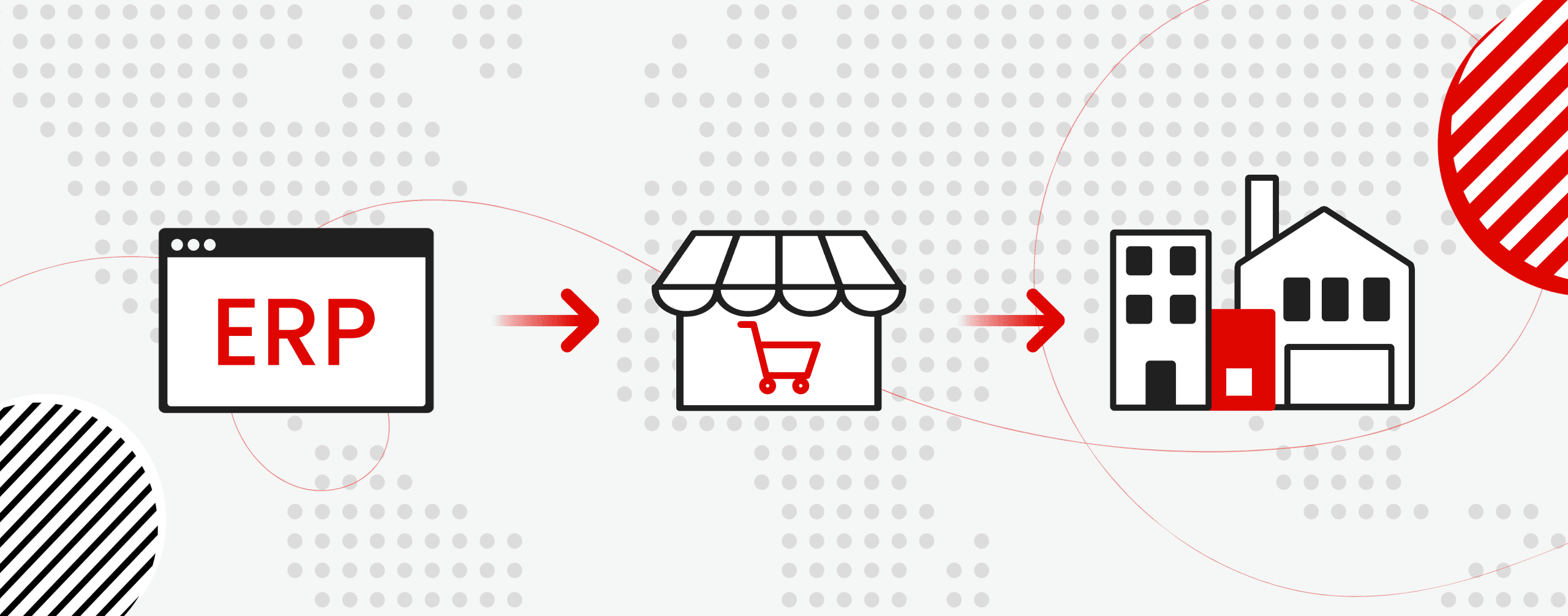
Enterprise resource planning (ERP) and e-commerce are related through the way they connect a company’s internal operations with its external customer-facing storefront. In B2B settings, ERP systems serve as the operational core—managing inventory, financials, customer data and supply chains. E-commerce platforms, on the other hand, are the online store where customers browse products, place orders and track shipments.
When these systems are siloed, businesses struggle with data inconsistencies, manual entry and delays. But when integrated, ERP and e-commerce work together to automate order processing, sync product and pricing data in real time and provide a seamless buying experience. This relationship is especially important in B2B commerce, where transactions are often recurring, complex and tailored to long-term customer relationships.
According to a 2023 Gartner report, 83% of B2B buyers prefer to order and pay through digital channels when given the option—making ERP and e-commerce integration more critical than ever. Businesses exploring the latest trends in B2B ecommerce recognize the shift underway: today’s B2B buyers expect the same ease of use, transparency and speed they get from consumer platforms.
Whether it’s a new customer researching your catalog for the first time or a long-standing buyer reordering monthly inventory, a digital storefront powered by ERP integration is increasingly expected—and often, a deciding factor in who wins the sale.
- Why Integrating ERP with Ecommerce Matters for B2B Growth
- Key ERP-Integrated Ecommerce Features and Capabilities
- Industry Use Cases for ERP-Integrated Ecommerce Solutions
- How to Choose the Right ERP-Integrated Ecommerce Platform
- How to Launch ERP-Integrated Ecommerce: Best Practices and Next Steps
- Common Challenges of Disconnected ERP and Ecommerce Systems
- How k-ecommerce Transforms Common ERP Challenges into Growth Opportunities
Why Integrating ERP with Ecommerce Matters for B2B Growth
Seamless ERP and online store integration gives manufacturers and distributors a clear edge in a competitive market. Instead of juggling disconnected systems and patching together workflows, companies can focus on delivering real value to customers.
An integrated ERP B2B e-commerce solution offers the following benefits:
- Consistent, real-time data: Inventory, pricing and product information stays accurate across all channels.
- Customer-specific experiences: Use ERP data to personalize online catalogs, manage pricing contracts and tailor payment terms.
- Automation of order flows: Eliminate manual re-entry with direct syncing from e-commerce to ERP, reducing labor and errors.
- Scalability for new channels: Add customer portals, marketplaces or D2C stores without overhauling operations.
- Alignment with buyer expectations: B2B customers now expect self-service, transparency and speed in every transaction.
For growing manufacturers and distributors, ERP integration in ecommerce cuts down on order entry time, reduces dependency on internal staff, lowers the risk of human error and accelerates fulfillment. By keeping pricing, product data and inventory aligned between systems, businesses can respond faster to customer needs, scale without adding overhead and deliver the always-on buying experience modern B2B buyers demand.
Key ERP-Integrated Ecommerce Features and Capabilities
Ecommerce ERP integration isn’t just a backend upgrade—it’s what ties together the systems your business relies on every day. When done right, it improves how your team works, how customers interact with your brand and how smoothly everything runs behind the scenes. Here are the key areas where integration makes the biggest impact:
- Inventory Management: Maintain ERP inventory visibility for e-commerce across warehouses and channels. Real-time data prevents overselling and enables accurate lead times.
- Order Management: Automate order capture and processing. An ERP order fulfillment automation setup ensures orders placed online flow directly into the ERP system for fast fulfillment.
- Pricing and Discounts: Show accurate, contract-based pricing online using ERP logic. This ensures transparency and reduces disputes.
- Customer Relationship Management: Use ERP-integrated customer data for targeted marketing, order history views and account management.
- Financials and AR: Streamline billing with ERP invoice automation for ecommerce and integrate AR tools like KIP, the ERP-integrated payment solution. It’s built-in ERP invoice automation for ecommerce simplifies accounts receivable, giving finance teams better visibility and faster reconciliation.
- Shipping and Logistics: Provide real-time shipping quotes, options and tracking, with updates fed from your ERP system.
These capabilities support powerful B2B customer portals and reduce manual intervention at every step. A well-built portal allows business buyers to browse personalized catalogs, place bulk or recurring orders, review order history, track shipments and manage payments—all without contacting sales or customer service.
This self-service functionality improves accuracy, speeds up transactions and gives internal teams back valuable time. For manufacturers and distributors, it also provides a consistent brand experience and a scalable path to grow customer accounts without increasing headcount.
Industry Use Cases for ERP-Integrated Ecommerce Solutions
Not every B2B company operates the same way, but most face similar roadblocks without seamless ERP e-commerce integration.
- Manufacturing: Complex product configurations and long lead times can be simplified with ERP-connected product catalogs, BOM management and CPQ tools.
- Distribution and Wholesale: Volume orders, tiered pricing, backorders and warehouse routing all benefit from ERP-driven automation.
- Retail to B2B or D2C Expansion: A unified ERP and ecommerce system makes it easier to track inventory, avoid channel conflicts and serve multiple customer types.
Disconnected systems result in bottlenecks, like mismatched stock counts, outdated pricing or delayed shipments. These are high-stakes problems in sectors like automotive parts, construction supplies, medical equipment and agriculture.
For companies that manually enter orders from email or phone, the shift to ERP ecommerce integration can be transformational.
How to Choose the Right ERP-Integrated Ecommerce Platform
Not all ecommerce platforms are built to handle ERP integration for manufacturers. You need a solution that’s tailored for complex B2B needs and scalable for future growth.
Here’s what to look for:
- Native ERP integration: Out-of-the-box compatibility with Microsoft Dynamics and Acumatica is critical. Solutions like k-ecommerce for ERP integration offer prebuilt connectors.
- Scalability and performance: Ensure the platform can handle high transaction volumes, multi-warehouse routing and growing product catalogs.
- Intuitive UX: Your team and customers need a clean, responsive interface that doesn’t require technical workarounds.
- Integrated ERP payment processing: Automate credit card, ACH and terms payments directly from the ERP for a full AR sync.
- Support and onboarding: Look for providers who offer onboarding help and ongoing support to avoid roadblocks.
- Customization: From branded experiences to workflow adjustments, flexibility matters in B2B commerce.
When evaluating platforms, it’s helpful to look at the top ERP solutions in ecommerce to understand which systems are built to handle the demands of integrated digital commerce. Microsoft Dynamics and Acumatica both stand out for their flexibility, scalability and robust B2B capabilities. Microsoft Dynamics integrates seamlessly with a variety of third-party applications and supports complex pricing models and workflows.
Acumatica, meanwhile, is built for cloud-first scalability and offers powerful tools for inventory and financial management, making it ideal for growing mid-market manufacturers and distributors. The best ERP solutions don’t just connect your operations—they enable them to evolve, adapt and support multichannel commerce without adding complexity.
How to Launch ERP-Integrated Ecommerce: Best Practices and Next Steps
Even the best ERP-integrated ecommerce platform won’t succeed without a thoughtful rollout. Implementation is where digital transformation efforts often hit resistance—or stall entirely. To avoid common pitfalls, it’s essential to start with clear objectives, clean data and the right people at the table.
Here’s a step-by-step approach to guide your launch from internal alignment to post-launch optimization:
1. Align on Goals and KPIs
Before touching any systems, define what success looks like. Set measurable targets that matter to stakeholders across departments. For example:
- Increase order volume by 15% in the first year
- Reduce customer service calls by 30%
- Process 90% of orders without manual entry
This alignment ensures everyone is aiming at the same outcomes—and helps justify investment as results roll in.
2. Audit Your ERP and Data Health
Accurate product data, pricing tiers, customer records and inventory are the backbone of integration. If your ERP data is outdated or incomplete, the e-commerce experience will suffer. Take the time to clean and structure your data before moving forward.
3. Define Functional Requirements
Clarify what features are essential for your team and your customers. Prioritize high-impact capabilities like:
- Customer-specific pricing
- Custom catalogs
- Net terms payments
- Account-level ordering
Get input and sign-off from both IT and sales leadership to make sure nothing critical gets missed—or overbuilt.
4. Build the Right Implementation Team
Strong execution depends on the right mix of internal and external support. Appoint:
- An internal project lead (typically someone from IT or operations)
- External ecommerce/ERP integration specialists
- Cross-functional team members from sales, marketing and fulfillment
Start training early so teams are confident and ready at launch.
5. Choose a Proven ERP-Integrated Platform
Opt for a platform with native ERP integration—ideally with prebuilt connectors for Microsoft Dynamics or Acumatica. This reduces the need for custom development and simplifies future updates. K-ecommerce is a good example, offering a purpose-built solution that minimizes IT burden.
6. Roll Out in Phases
Start with a limited customer segment or product line. Use this controlled launch to:
- Work out integration bugs
- Collect usability feedback
- Fine-tune workflows
Then expand based on what you learn. A phased rollout limits disruption and builds momentum.
7. Optimize After Launch
A successful ecommerce site isn’t “set it and forget it.” It’s important to build in support for:
- Ongoing data sync and system health checks
- Internal user adoption and customer onboarding
- Continuous improvements based on analytics
- Marketing support to drive traffic and adoption
Leverage your ecommerce vendor’s documentation and team during this phase—they can often solve problems faster and more efficiently than your internal team can alone.
ERP-integrated ecommerce isn’t just about technology—it’s a business transformation. It touches your customers, your staff and your bottom line. By taking the time to align your team, clean your data and plan a structured rollout, you’ll be better positioned to drive growth, improve efficiency and meet the expectations of today’s B2B buyers.
Common Challenges of Disconnected ERP and Ecommerce Systems
Many manufacturers and distributors still rely on siloed systems or manual processes. This creates several challenges:
- Inconsistent data: Discrepancies between ERP and e-commerce platforms lead to inaccurate inventory levels, pricing mistakes and shipping issues.
- Manual re-entry: Re-keying orders from email into the ERP wastes time and opens the door to errors.
- Slow fulfillment: Without direct ERP integration, order processing is delayed and hard to track.
- Limited visibility: Sales, support and leadership teams lack a clear view of customer status or product availability.
- Higher costs: Manual work and avoidable mistakes increase labor costs and damage customer relationships.
- Falling behind: Competitors with integrated systems can offer self-service, faster response times and greater accuracy.
For businesses still juggling disconnected systems, embracing ERP integration in ecommerce creates a single source of truth—automating order processing, syncing real-time inventory and delivering customer-specific pricing without manual work.
How k-ecommerce Transforms Common ERP Challenges into Growth Opportunities
These operational roadblocks aren’t just headaches—they’re signals that your systems are holding you back. With k-ecommerce, ERP and online store integration becomes a launchpad for smarter, faster, more profitable operations. Here’s how the platform turns common B2B challenges into real competitive advantages.
Streamlined Data and System Integrity
Instead of constantly chasing down mismatches in inventory, pricing or customer records, k-ecommerce ensures consistency across every system and channel. Its native ERP integration for Microsoft Dynamics and Acumatica keeps product data, tax rules, pricing and account information synchronized in real time—no manual corrections or risky middleware required.
Faster Fulfillment and Operational Agility
Speed matters, especially in B2B where delays can derail production. K-ecommerce connects customer-facing portals directly to ERP fulfillment logic, so orders move from cart to pick-pack-ship with zero rekeying. Backorders, tracking updates and shipment statuses flow automatically between systems, giving your team and your customers total visibility.
Transparent, Self-Service Customer Experience
Modern B2B buyers want consumer-level convenience with enterprise-level control. K-ecommerce enables 24/7 self-service portals that surface ERP-stored account details, invoices, personalized catalogs, and order history. Sales and support teams stay informed without digging through disconnected records—and customers get the speed and transparency they expect.
Reduced Overhead and Increased Margin Control
Manual tasks and patchwork integrations eat into profit. K-ecommerce helps you automate ERP order capture and payment processing, validate every transaction against ERP rules (credit terms, pricing contracts, tax logic) and minimize human error at every step. The result: lower costs, fewer returns and happier customers. With integrated ERP payment processing, k-ecommerce enables automated credit card, ACH or terms-based billing directly from your ERP—saving time and reducing billing errors.
Built for Scale, Without IT Burnout
You don’t need to reinvent your tech stack or overload your IT team. K-ecommerce provides a ready-to-deploy customer portal framework that’s purpose-built for B2B and deeply integrated with the systems you already use. As your business grows, your ecommerce experience scales with it—without breaking your back office.
K-ecommerce provides an ERP-connected customer portal designed for the needs of modern B2B buyers. To see how this plays out in real-world B2B environments, request a demo of k-ecommerce or explore the ERP ecommerce solution that fits your growth goals.