
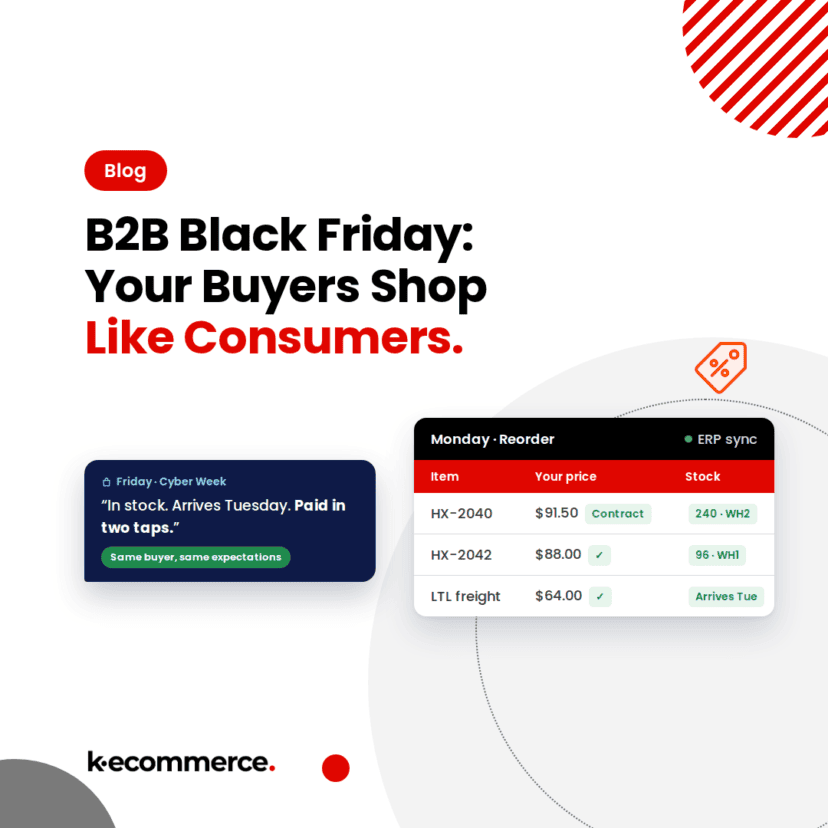
B2B Black Friday: Your Buyers Shop Like Consumers, and Expect the Same at Work

On Friday, a purchasing manager compares prices for a new TV in under a minute. She sees which store has it in stock, picks a delivery date, and pays with two taps on her phone.
On Monday, she logs into a supplier’s portal to reorder 40 cases of a product she buys every month. The price on screen isn’t her contract price. Stock says “call for availability.” Freight will be “confirmed by email.”
Same person. Same week. Two very different experiences.
That’s what Black Friday and Cyber Monday really mean for B2B. For some suppliers, it’s a sales event. For every supplier, it’s the week your buyers are reminded — dozens of times — how easy buying online can be. And they bring that standard back to work.
What Black Friday and Cyber Monday Really Mean for B2B
For B2B companies, Cyber Week plays two roles at once.
1. A Sales Moment, for Some
B2B suppliers are no longer sitting it out. In DHL’s 2025 eCommerce Trends Report, 85% of B2B-focused sellers planned to take part in Black Friday, and 63% said their Black Friday sales grew the year before (Distribution Strategy Group, Nov. 27, 2025). Some industrial distributors now run dedicated Black Friday pages, while others keep steady, year-round pricing on purpose.
2. An Expectation-Setting Moment, for Everyone
This is the part most B2B companies overlook. Adobe expects U.S. consumers to spend a record $275.1 billion online this holiday season, with Cyber Monday alone topping $15 billion (Adobe, Sept. 28, 2026). A record 63% of Thanksgiving spending is expected on mobile, and traffic from AI shopping tools is set to rise 130%.
Every one of those shoppers has a job. Many of them are purchasing agents, procurement teams, operations managers, and business owners — the people who order from you. During Cyber Week, they get a crash course in what “easy” looks like: instant prices, live stock, delivery dates up front, fast checkout, and real-time tracking.
They don’t switch that standard off on Monday morning. And the data shows it:
- They prefer to serve themselves. In a March 2026 Gartner survey, 67% of B2B buyers said they prefer a buying experience without a sales rep (PwC, May 25, 2026).
- They’re comfortable buying big online. 73% of B2B decision-makers are now comfortable placing orders over $50,000 online, up from 59% in 2022 (McKinsey, 2026 B2B Pulse, May 28, 2026).
- They leave when information doesn’t match. In the same McKinsey survey, inconsistent information was the top reason B2B buyers switched suppliers.
In other words, your web store isn’t only compared with your competitors’ web stores. It’s compared with the best sites your buyers used last weekend.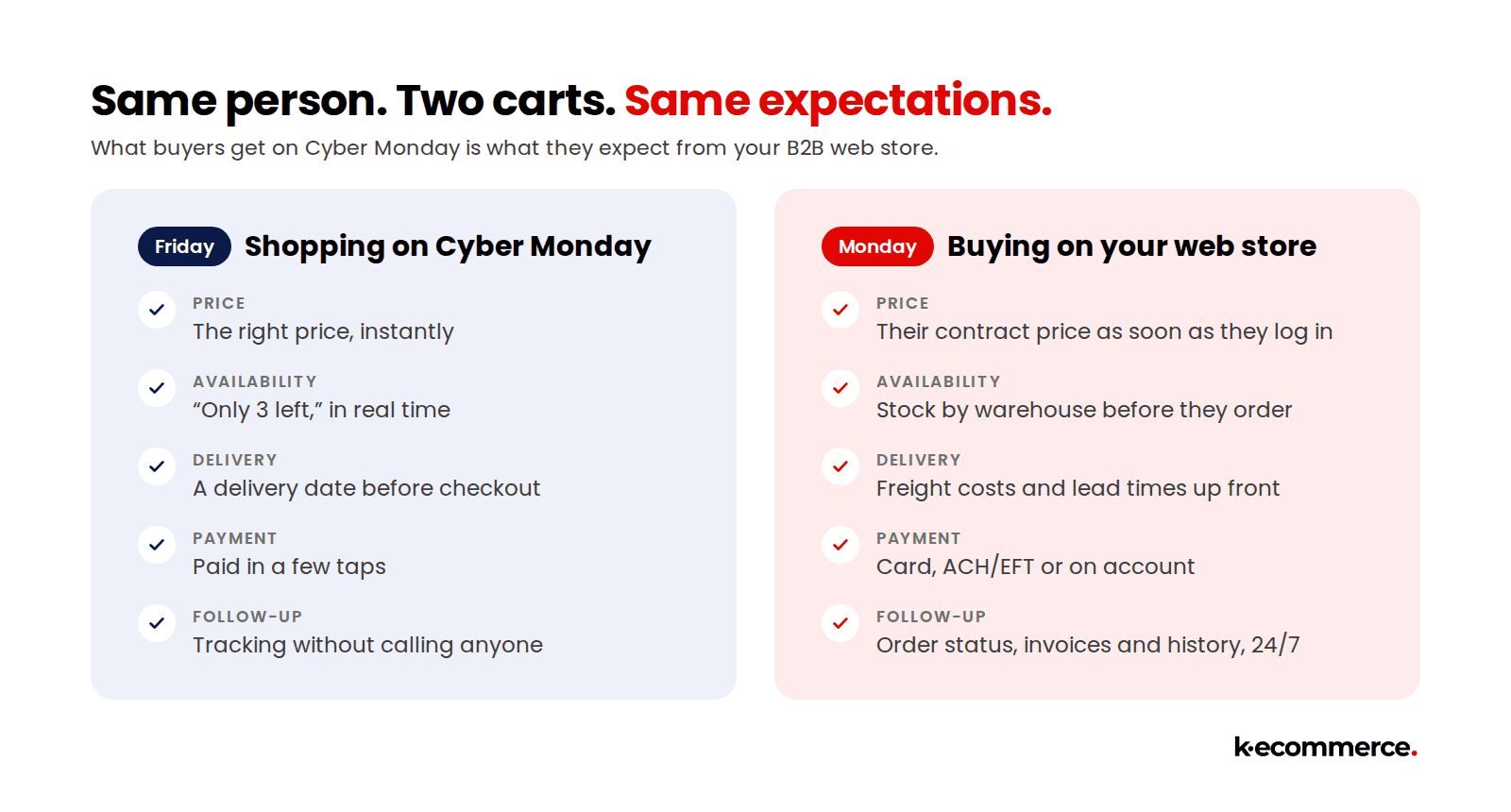
Notice the pattern in the right-hand column. None of it is about design or discounts. Almost every expectation depends on one thing: accurate data, available the moment the buyer needs it.
Why It’s Harder in B2B (and Why That’s No Excuse)
A retail site has it easy by comparison: one public price, one shopper, one card, one shipping address. A B2B order rarely looks like that. Behind a single reorder there can be:
- A negotiated contract price, plus volume breaks and a special unit of measure
- Several ship-to locations, each with its own warehouse and freight rules
- A PO number, an approver, and payment terms
- A catalog that’s different for every customer
Your buyers know B2B is more complex. They just don’t think the complexity should be their problem.
The Real Gap Is Usually Behind the Screen
When a B2B web store feels clunky, the cause is rarely the storefront itself. It’s the connection between the storefront and the ERP:
- Prices sync overnight, so contract changes made today don’t show online until tomorrow.
- Stock is a daily snapshot, so “in stock” can be wrong by noon.
- Orders are re-keyed, so confirmations and tracking lag hours or days behind.
- Invoices live only in the ERP, so buyers have to call or email to see what they owe.
McKinsey’s 2026 research makes the same point: misaligned pricing and conflicting information are increasingly visible to customers, and increasingly costly to sellers. As we covered last month in AI in B2B Ecommerce: Don’t Let Bad Data Turn a Treat Into a Trick, the fix starts with your data — not with a new layer of features on top of it.
The goal is simple to describe: consumer-easy on the outside, B2B-accurate underneath.
So, Should You Run a B2B Black Friday Promotion?
The honest answer: it depends, and it matters less than you might think.
If your products suit it — overstock to clear before year-end counts, a new line to introduce, or supplies buyers stock up on before Q1 — a targeted Cyber Week offer can work well. Keep it B2B-friendly:
- Never undercut a negotiated price. A promotion should never show a contract customer a higher price than the one they already have.
- Favor volume breaks, bundles, or free freight over blanket percentage discounts. They fit how B2B buyers purchase and protect margin.
- Be clear on dates and cutoffs, including the last order date for delivery before year-end.
If promotions don’t fit your business, skip them. Many distributors keep steady pricing all year on purpose. What you can’t skip is the experience: the buyer who spent the weekend on retail sites will judge your web store on Monday either way.
From “Buy Now, Pay Later” to “Pay Your Invoice Online”
Payment is where the consumer and B2B worlds look most different, and where expectations are converging fastest. Adobe expects buy now, pay later to drive $21.3 billion in holiday spending this season, including more than $1 billion on Cyber Monday alone. Consumers have learned that paying should be flexible, quick, and done on their own schedule.
B2B has had flexible payment for decades. It’s called payment terms. What’s often missing is the convenience around it. Checks still account for 26% of B2B payments in the U.S. and Canada, and AFP puts the median cost of issuing one at $2.01 to $4, versus 26 to 50 cents for an ACH payment (Nacha, citing the 2025 AFP Digital Payments Survey).
The B2B version of a modern checkout looks like this:
- Buyers can order on account, or pay by card or ACH/EFT at checkout.
- They can see their statement and pay one invoice, several invoices, or a partial amount online.
- They can pay from a link in their invoice email, without calling accounts receivable.
- Every payment lands in the ERP automatically, so nobody matches remittances by hand.
Where k-ecommerce Fits
Meeting consumer-level expectations in B2B starts with keeping your web store and ERP in agreement. That’s the part k-ecommerce focuses on. Our web stores sync in real time, in both directions, with Microsoft Dynamics 365 Business Central, Dynamics GP, Acumatica, and other leading ERPs — with no batch jobs and no middleware. That means buyers see:
- Their own prices and catalogs, straight from the ERP, even with complex pricing
- Inventory by warehouse, updated as it changes
- Real-time freight rates before checkout, including LTL
- Fast reordering through quick order entry, CSV upload, and one-click reorder
- Self-service order tracking, invoices, and history, 24/7, in a B2B customer portal
For Business Central and GP users, our KIP payment solution adds a customer payment portal and in-ERP payment processing, with automatic cash receipt entries. Stahls’ Transfer Express processed more than 1,400 payments — nearly $1.2M — through KIP in seven months, without adding staff.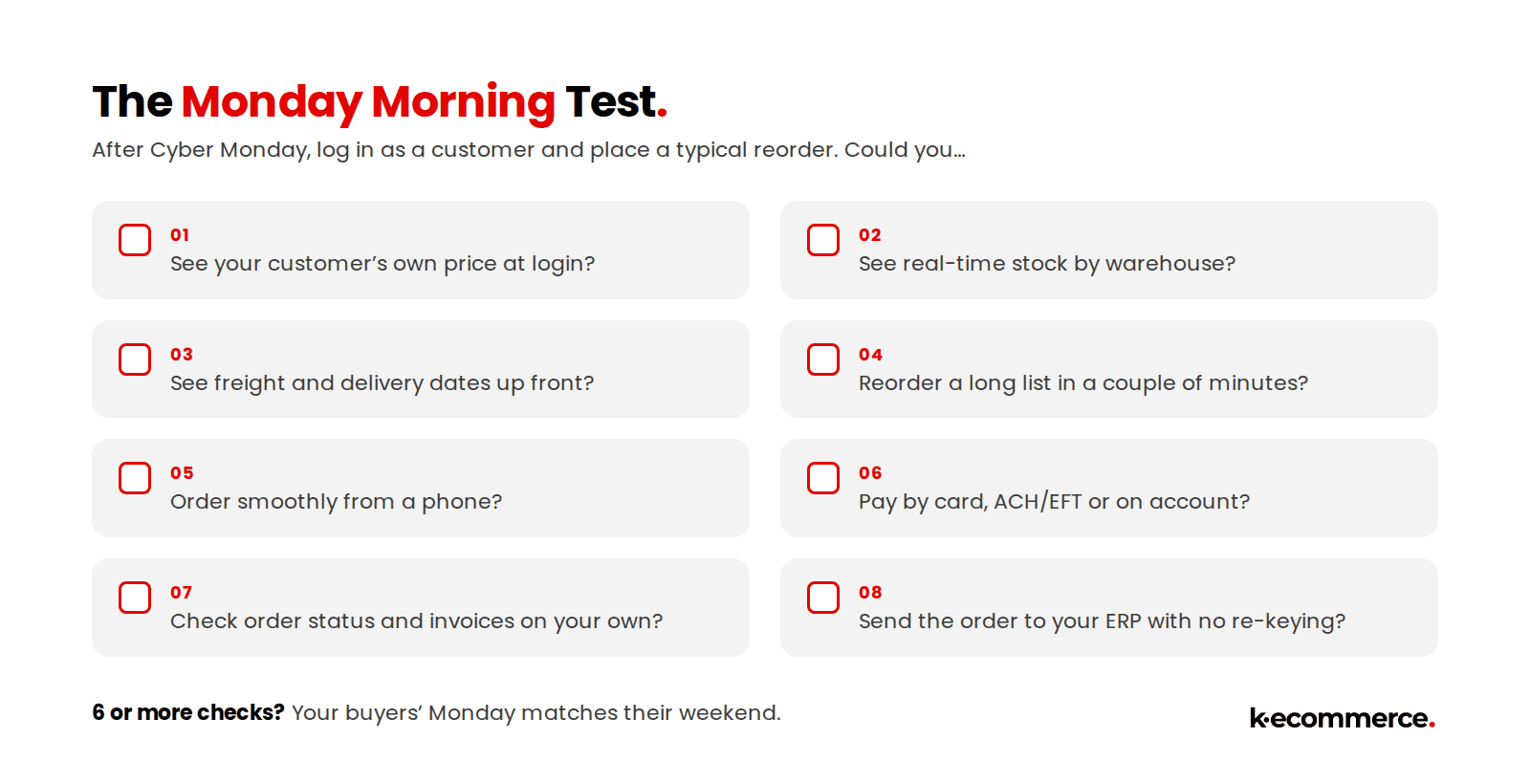
FAQ
Is Black Friday relevant for B2B companies? Yes, in two ways. Many B2B sellers now run Cyber Week offers — 85% of B2B-focused sellers planned to take part in Black Friday in DHL’s 2025 research. And even if you don’t, your buyers spend that week shopping as consumers, which raises their expectations of every web store they use, including yours.
What do B2B buyers expect from a web store today? Their own prices as soon as they log in, real-time stock, freight costs before checkout, fast reordering, mobile access, flexible payment options, and 24/7 access to orders and invoices. Gartner found that 67% of B2B buyers prefer a buying experience without a sales rep.
Should B2B companies offer Black Friday discounts? Only if they fit your products and margins. If you do, keep offers targeted, never undercut negotiated prices, and favor volume breaks or free freight over blanket discounts.
Give Your Buyers a Monday That Matches Their Weekend
Your buyers already know what an easy online experience feels like. See how k-ecommerce keeps your web store in sync with your ERP, so every buyer gets the right price, real availability, and an easy way to pay — on Cyber Monday and every Monday after.
Sources
- Adobe: U.S. Holiday Shopping Season to Hit Record $275.1 Billion Online — Adobe, September 28, 2026
- The surprising economics of B2B growth (2026 Global B2B Pulse Survey) — McKinsey, May 28, 2026
- The new B2B buyer standard — PwC, May 25, 2026 (citing a March 2026 Gartner sales survey)
- Black Friday Gains Ground in B2B as Distributors Roll Out Verified Promotions — Distribution Strategy Group, November 27, 2025 (citing the 2025 DHL eCommerce Trends Report)
- Business-to-Business (B2B) — Nacha, citing the 2025 AFP Digital Payments Survey
- Stahls’ Transfer Express KIP results — k-ecommerce success stories