



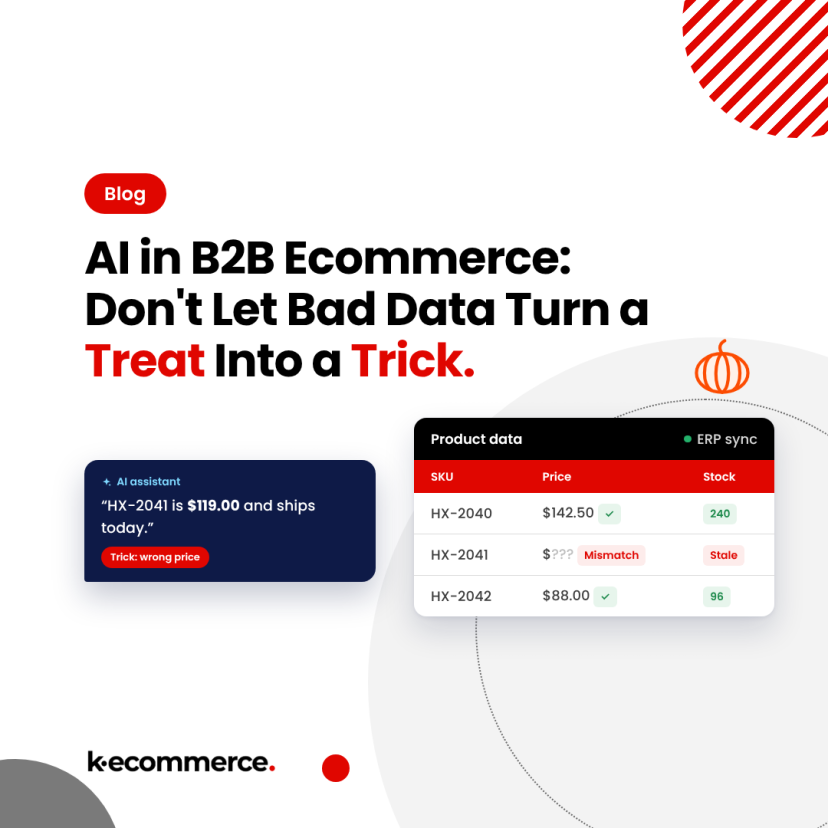
AI in B2B Ecommerce: Don’t Let Bad Data Turn a Treat Into a Trick

October is the month for masks. And in B2B ecommerce, AI is wearing one of the most convincing costumes of the year.
Every platform, plug-in, and keynote promises AI that recommends the right products, answers buyer questions instantly, and maybe even places orders on its own. Some of that promise is real. But here’s the part that rarely makes the slide deck: AI doesn’t know your business. It knows your data.
If your product information, pricing, and inventory are incomplete or out of sync, AI won’t fix the problem. It will repeat it — faster, at scale, and with total confidence. So before you decide whether AI is a trick or a treat for your business, look at what’s underneath the mask: your data foundation.
AI Is Already Part of the B2B Buying Journey
AI in B2B ecommerce isn’t a future scenario anymore. It’s showing up on both sides of the transaction.
On the buyer’s side, generative AI has become a research tool. In Forrester’s The State of Business Buying, 2026, generative AI tools were the single most cited meaningful interaction type for researching purchases (Digital Commerce 360). Gartner goes further: it predicts AI agents will intermediate more than $15 trillion in B2B spending by 2028 (Digital Commerce 360).
On the seller’s side, AI is being built into the tools buyers touch every day:
- Smarter site search that understands what a buyer means, not just what they typed
- Product recommendations and “frequently ordered together” suggestions
- Chat assistants that answer questions about specs, availability, and order status
- Faster quoting and reordering
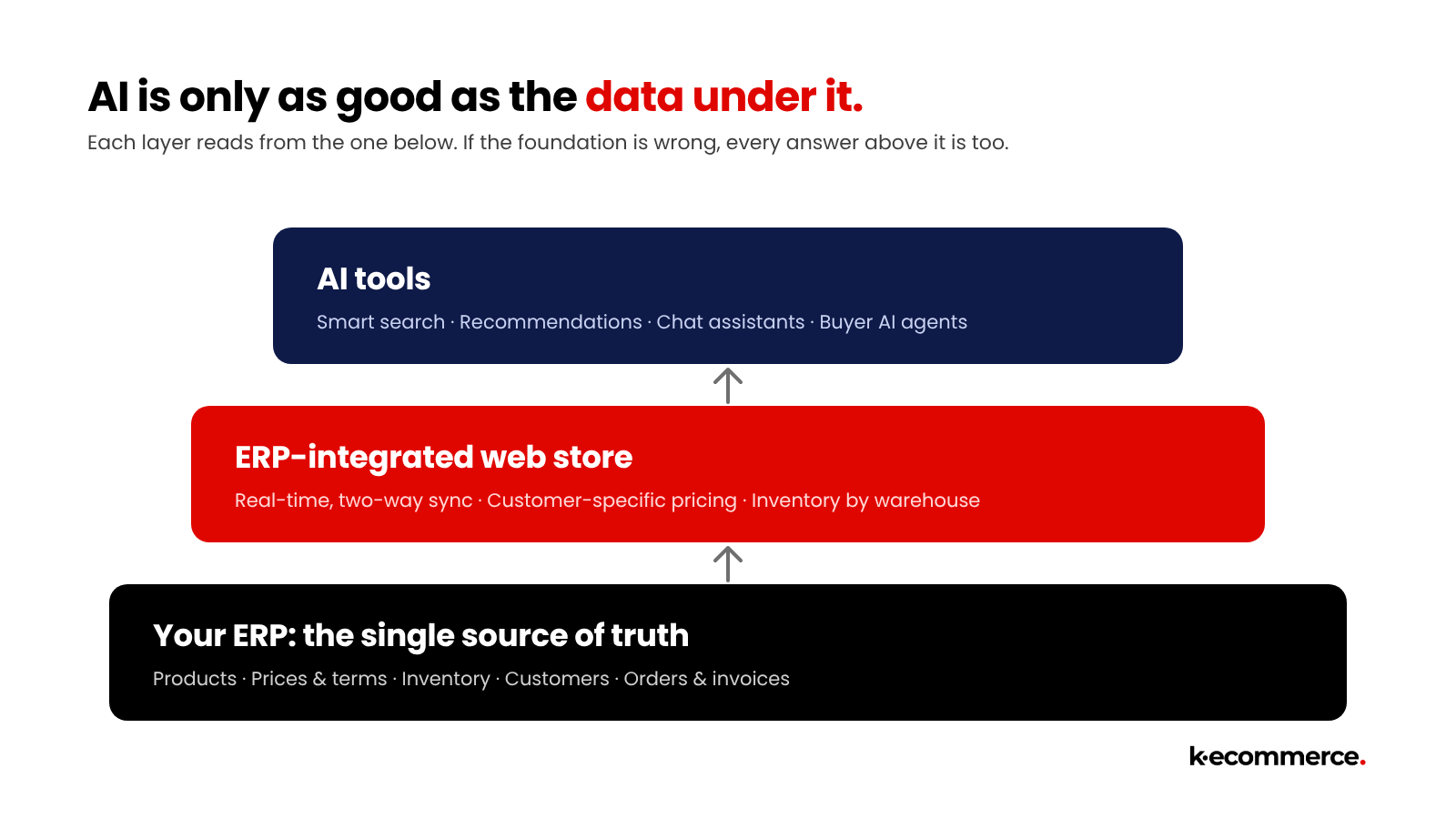
Here’s what all of these have in common. Whether the AI belongs to your buyer or sits on your web store, it pulls from the same place: your product, pricing, inventory, and customer data. The quality of the answer can never be better than the quality of that data.
The Scary Part: AI on Bad Data
“Garbage in, garbage out” is an old rule. AI just makes it louder. A person who spots a strange price on a screen will usually stop and check. An AI assistant won’t — it will present that price politely, instantly, and to every buyer who asks.
In B2B, that looks like this:
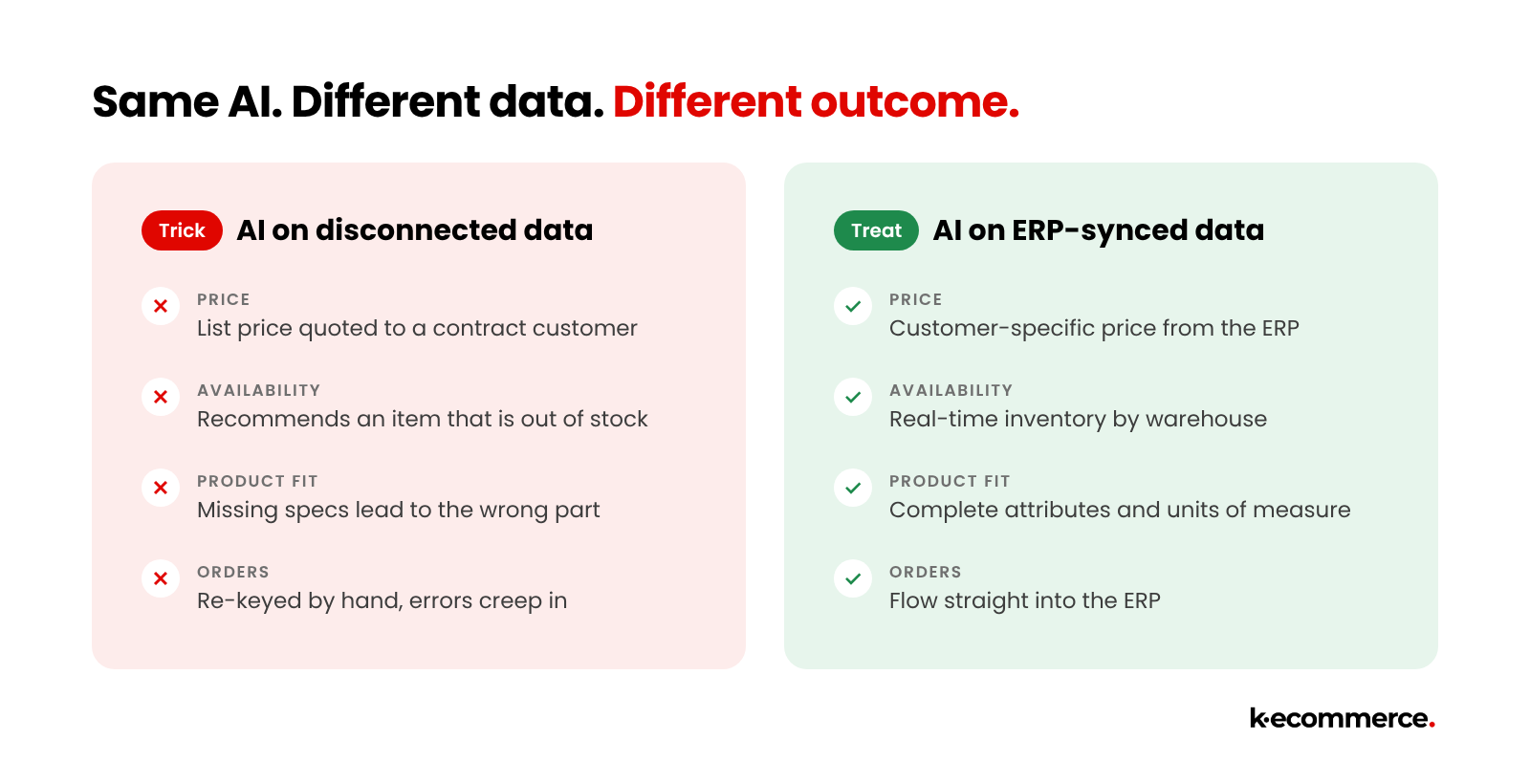
- The wrong price, with confidence. A contract customer asks your assistant for a quote and gets list price, because their negotiated pricing lives in the ERP and never reached the web store. You either eat the margin or lose the buyer’s trust.
- The phantom product. AI recommends an item that’s out of stock, discontinued, or only available in another warehouse. The order goes through, then turns into a backorder and a support call.
- The wrong part. A missing unit of measure or an incomplete spec sheet leads to a recommendation that looks right but doesn’t fit. In manufacturing and distribution, that means returns, delays, and an unhappy customer.
- The invisible catalog. If a buyer’s AI agent compares suppliers and your product data is thin or inconsistent, it may simply skip you.
The research backs this up. Gartner predicts that through 2026, organizations will abandon 60% of AI projects that aren’t supported by AI-ready data, and 63% of organizations either lack or aren’t sure they have the right data management practices for AI (Gartner). Buyers feel it too: in Forrester’s research, 20% of B2B buyers said they felt less confident in a decision because they ran into unreliable or inaccurate information from generative AI (Digital Commerce 360).
The takeaway isn’t “avoid AI.” It’s that AI is an amplifier. Good data gets more useful. Bad data gets more expensive.
What an AI-Ready Data Foundation Looks Like in B2B
An AI-ready foundation isn’t a new piece of software. It’s the data you already run your business on, kept complete, accurate, and in sync everywhere buyers see it. For most manufacturers and distributors, that starts with the ERP.
Data | What AI needs from it | What happens when it’s off |
Product information | Complete attributes, specs, units of measure, variants, images, documents | Wrong recommendations, wrong parts, products AI can’t find or compare |
Pricing | Customer-specific prices, contract terms, volume breaks, UoM pricing | Wrong quotes, margin leaks, broken trust with key accounts |
Inventory | Real-time availability by warehouse, lead times | Promises you can’t keep, backorders, extra support calls |
Customers | Accurate accounts, catalogs, permissions, payment terms | Buyers see products or prices they shouldn’t, or miss ones they should |
Orders and invoices | Clean order history, statuses, invoices | Weak reorder suggestions, “where’s my order?” calls, A/R headaches |
Three principles hold it all together:
- One source of truth. Product, price, and inventory data should come from your ERP, not from a spreadsheet someone exports on Fridays.
- No re-keying. Every time an order is typed from one system into another, an error can sneak in. Automation removes that risk at the source.
- Real-time, not overnight. Batch updates mean your web store — and any AI on top of it — is always a few hours behind reality.
How ERP-Integrated Ecommerce Builds the Foundation Today
You don’t need to wait for the next AI release to start fixing your data. ERP-integrated ecommerce does the groundwork now — and pays off on day one, AI or not.
That’s where k-ecommerce focuses. We’re not here to sell you an AI story. We make sure the data your buyers see online is the same data your ERP runs on:
- Real-time, bi-directional sync with Microsoft Dynamics 365 Business Central, Dynamics GP, Acumatica, and other leading ERPs — no batch jobs, no middleware
- Customer-specific pricing and catalogs pulled straight from the ERP, so every buyer sees their own prices and terms
- Inventory by warehouse, updated as it changes
- Orders and payments that flow back into the ERP automatically, so nobody re-keys them and errors don’t creep into your records
When you’re ready to add AI-powered tools to your business, a synced, accurate foundation means they start from the truth instead of a guess.
Trick or Treat? A 7-Point Data Health Check
Before you add any AI tool to your buying experience, run through these questions. Every “no” is a trick waiting to happen.
☐ Does your web store pull product, pricing, and inventory data directly from your ERP?
☐ Does every buyer see their own customer-specific prices, catalogs, and terms online?
☐ Is inventory updated in real time, by warehouse, rather than once a day?
☐ Are your product attributes, specs, and units of measure complete and consistent across the catalog?
☐ Do online orders reach your ERP without anyone re-keying them?
☐ Can buyers check order status, invoices, and payments on their own, 24/7?
☐ Is there a clear owner for product and pricing data quality in your organization?
Five or more checks? Your foundation is in good shape. Fewer than five? Start there — it’s the most valuable AI investment you can make this year.
Key Takeaways
- AI is already part of how B2B buyers research and buy, and AI agents are expected to handle a growing share of B2B spending.
- AI is only as good as the data it reads. Wrong prices, stale inventory, and incomplete product data get amplified, not fixed.
- For manufacturers and distributors, the ERP is the natural source of truth for AI-ready data.
- ERP-integrated ecommerce builds that foundation now and delivers results on its own: fewer errors, less manual work, and better buyer experiences.
FAQ
What does “AI-ready data” mean in B2B ecommerce? It means your product, pricing, inventory, and customer data is complete, accurate, consistent, and up to date wherever it’s used. In practice, that means it comes from one source of truth — usually the ERP — and syncs in real time to your web store.
Do I need AI on my B2B web store right now? Not necessarily. Many of the biggest gains in B2B ecommerce still come from the basics: accurate customer-specific pricing, real-time inventory, easy reordering, and self-service. Getting those right is also what makes future AI tools useful.
Why is the ERP so important for AI? Your ERP already holds the data that matters most to buyers: products, prices, stock, orders, and invoices. If your ecommerce platform is natively integrated with it, AI tools can work from the same trusted data your team uses every day.
What’s the biggest risk of adding AI before fixing my data? AI will repeat your data problems at scale. A wrong price or an out-of-stock recommendation that a person might catch becomes an instant, confident answer to every buyer who asks.
No Tricks, Just a Solid Foundation
AI will keep evolving. Your data is what decides whether it works for you or against you. See how k-ecommerce keeps your web store in sync with your ERP, so every buyer gets the right product, the right price, and the right availability — every time.